Betting opens
The next round's market opens and you choose your ball and bet type.

Gogoli is a colour-ball racing game. Six balls run a virtual track, you back one to finish first — or predict an exact order for a bigger return — and the whole thing resolves in under sixty seconds before the next round opens.
It sits between a sportsbook and a casino table: the presentation of a race, the mechanics of an instant-win game.
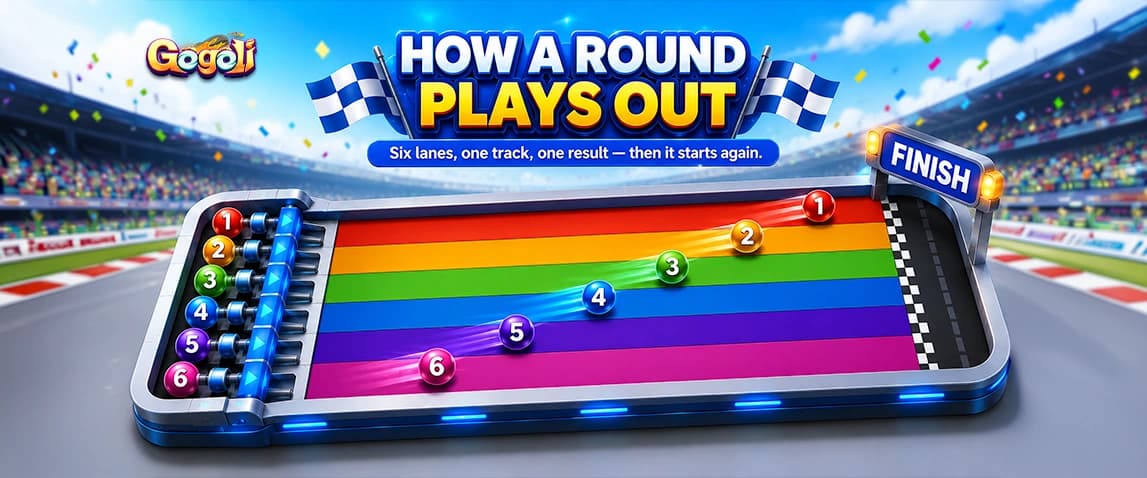
The next round's market opens and you choose your ball and bet type.
The market locks. Nothing can be added or withdrawn from this point.
The balls run the track and the finishing order is displayed.
Winning bets credit to your wallet and the following round opens.
Timings are approximate and vary slightly between rounds. The exact betting window is shown on screen as it counts down.
Returns scale with how precisely you have to be right. The bar shows relative payout, not a fixed multiplier.
Back one ball to finish first. The simplest bet on the card and the one most rounds are played on.
Name the first two finishers without specifying which comes first. Harder than a straight winner, and priced accordingly.
First and second in the precise order they finish. Roughly twice as hard as the same pair in any order.
The first three finishers in exact sequence. The largest advertised returns on the game, and by some distance the least likely to land.
Available bet types and their exact multipliers are set by the provider and shown in the game before you stake. Higher payouts exist because those outcomes occur less often — the pricing reflects the difficulty, it does not reward you for taking it on.
This is the part worth being clear about, because the presentation can suggest otherwise.
The finishing order is generated by a certified random number generator before the animation plays. The balls are not physically racing and no ball has form, condition or a track preference. What you watch is the result being shown to you, not determined.
Every round is independent. A colour that has won four times running is no more or less likely to win the next one, and a colour that hasn't appeared in twenty rounds is not "due". Result histories displayed on screen are a record, not a pattern.
A sixty-second cycle means up to sixty rounds an hour. At RM10 a round that is RM600 of stake through your balance in an hour, which is considerably faster than most casino formats. The odds per round are unaffected — the rate of spend is not. A deposit limit is a more reliable control here than deciding to stop after a set time.
Gogoli is a game of chance. No strategy, colour selection or timing changes the odds of a round. Set a budget before you start and use the deposit limits in your account settings.
A colour-ball racing game. Six balls run a virtual track, you bet on which finishes first or on an exact finishing order, and each round completes in about sixty seconds.
No. The finishing order is produced by a certified random number generator before the animation plays. The balls have no form or condition, and the race you watch is the result being displayed rather than determined.
No. Each round is independent. A colour that has won repeatedly is no more likely to win again, and one that has not appeared recently is not due. Result histories are a record, not a pattern.
The straight Winner bet. Exact-order combinations pay far more because they land far less often — worth understanding the cycle on simple bets first.
Roughly sixty seconds from betting open to payout. That allows up to sixty rounds an hour, so stake accumulates quickly — a deposit limit is more useful than a time limit.
No. Gogoli runs in your browser through the M2 lobby on mobile and desktop. The M2 app is optional.
Winning bets credit to your main wallet as soon as the round settles, ready for the next round or for withdrawal through the cashier.